
Human Systems
Engineering
Don't Change People. Change Condition
Most organizations are working harder than they should.
They have capable leaders, strong teams, and a clear strategy. Yet execution slows, alignment drifts, and momentum fades. What often gets labeled as a people problem is rarely about talent, and it is rarely about strategy.
It is a structural friction problem.
HOW IT WORKS
Human Systems Engineering follows a disciplined structure:
Diagnose → Map → Adjust → Reinforce
We identify where friction exists, map how it shows up, adjust the conditions, and reinforce until momentum stabilizes.
No force required.
WHAT IT IS NOT
It is not motivational speaking.
It is not personality training.
It is not culture programming.
It does not fix people.
Human Systems Engineering focuses on the conditions that shape how people operate.
THE RESULT
When structural friction is reduced:
Decisions accelerate.
Coordination improves.
Effort feels lighter.
Momentum becomes a system outcome, not something that requires constant push.
Three Structural Drivers
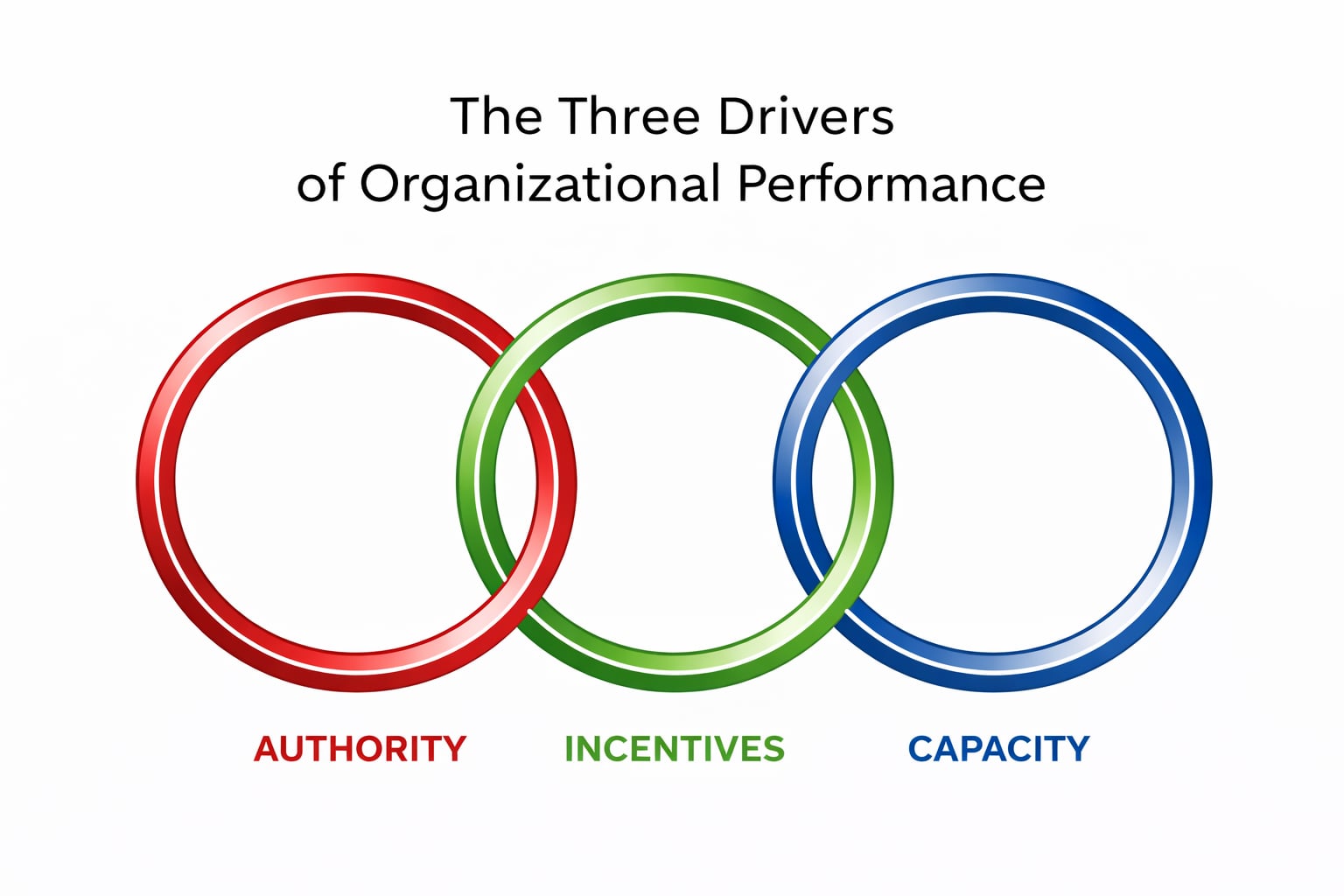
Every organization operates through three structural drivers: authority, incentives, and capacity.
Authority determines who decides and where ownership truly sits.
Incentives shape what behaviors are actually rewarded, often in subtle ways.
Capacity reflects whether leaders and teams have the bandwidth and support to execute.
When these drivers are misaligned, friction compounds. When they are aligned, energy flows and momentum increases.
AUTHORITY
Who decides?
Where does ownership truly sit?
Are roles clear or overlapping?Misaligned authority creates hesitation, duplication, and political friction.
INCENTIVES
What behaviors are actually rewarded?
Where are subtle contradictions embedded in the system?Incentive misalignment quietly redirects energy away from strategy.
CAPACITY
Do leaders and teams have the bandwidth, skill, and structural support to execute?
Overloaded systems create entropy—not underperformance.
These drivers determine how energy flows inside the organization.
When they are aligned, momentum increases.
When they are misaligned, friction compounds.
Five Domains Where Friction Hides
Structural friction tends to show up in predictable places.
Most of the time, what looks like a performance issue is actually a risk built into the system. Direction becomes unclear. Ownership becomes uneven. Alignment starts to drift. Trust lowers. Capacity stretches.
You can feel it when teams begin working harder, but results don’t follow.
Direction
Clarity around where the organization is going and what success looks like.
When this is strong, decisions become easier. When it is unclear, work becomes reactive and fragmented.
Ownership
Clarity of responsibility and accountability.
When this is strong, leaders are not carrying everything. When it is weak, work stalls and decisions bottleneck.
Alignment
Consistency across leaders and teams.
When this is strong, people move together. When it drifts, mixed signals and silent resistance begin to appear.
Trust
The level of psychological safety inside the system.
When this is present, ideas surface early. When it is low, people hold back and conversations move outside the room.
Capacity
The ability to execute with available time, energy, and resources.
When this is sufficient, momentum sustains. When it is stretched, fatigue and resistance increase.
Most organizations try to correct behavior after problems appear.
Human Systems Engineering focuses earlier — adjusting the conditions that produce those outcomes.
If you want a clearer view of how friction is showing up inside your organization, this model provides a simple starting point.
Download the full Five Domains of Risk overview here:
Copyrights 2026 | Human Systems Enginnering | All rights reserved