
Human Systems Engineering is not a one-time intervention.
It is a disciplined tuning process.
We work in four structured phases:
Diagnose → Map → Adjust → Reinforce
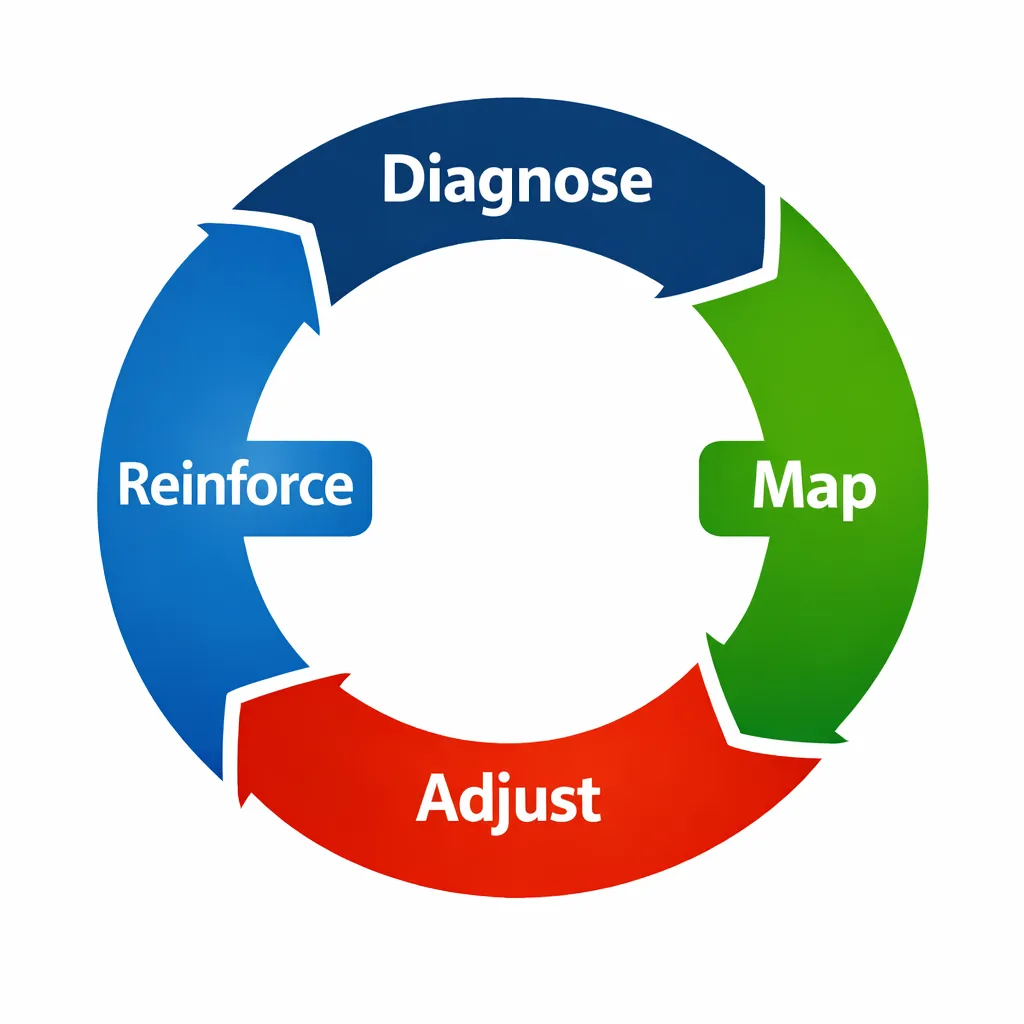
1. Diagnose
We begin by identifying structural friction—recurring patterns of stalled decisions, repeated tension, and unnecessary effort.
We look for patterns, not personalities.
Where does momentum slow?
Where does conflict repeat?
Where does leadership carry unnecessary weight?
This phase clarifies what is actually happening beneath the surface.
2. Map
Next, we identify the conditions producing those patterns.
How are expectations defined?
How are decisions made?
Where is accountability ambiguous?
Where is psychological safety fragile?
We make the invisible structure visible.
3. Adjust
Then we implement targeted structural shifts.
We refine meeting architecture.
Clarify decision rights.
Reset accountability definitions.
Align leadership orientation.
Small adjustments at high-leverage points create disproportionate momentum.
No force. Just design.
4. Reinforce
Structural change requires reinforcement.
We prevent drift.
Recalibrate when friction reappears.
Strengthen alignment under pressure.
Keep leverage points visible.
This is how improvement becomes durable.
Copyrights 2026 | Human Systems Engineering | All rightsreserved