
Human Systems
Engineering
Don't Change People. Change Condition
What Is Human Systems Engineering?
Most organizations are working harder than they should.
Capable leaders.
Strong teams.
Clear strategy.
Yet execution slows.
Alignment drifts.
Momentum fades.
This is rarely a talent problem.
It is rarely a strategy problem.
It is a structural energy problem.
Human Systems Engineering applies a thermodynamic lens to organizational performance:
Performance = Energy – Friction
Energy already exists inside your organization.
Talent. Intelligence. Effort. Commitment.
When performance stalls, it is usually because friction is absorbing usable energy.
Human Systems Engineering identifies and reduces structural friction so momentum can emerge naturally.
We don’t ask, “How do we change our people?”
We ask, “What conditions are shaping their behavior?”
Change the conditions, and behavior reorganizes.
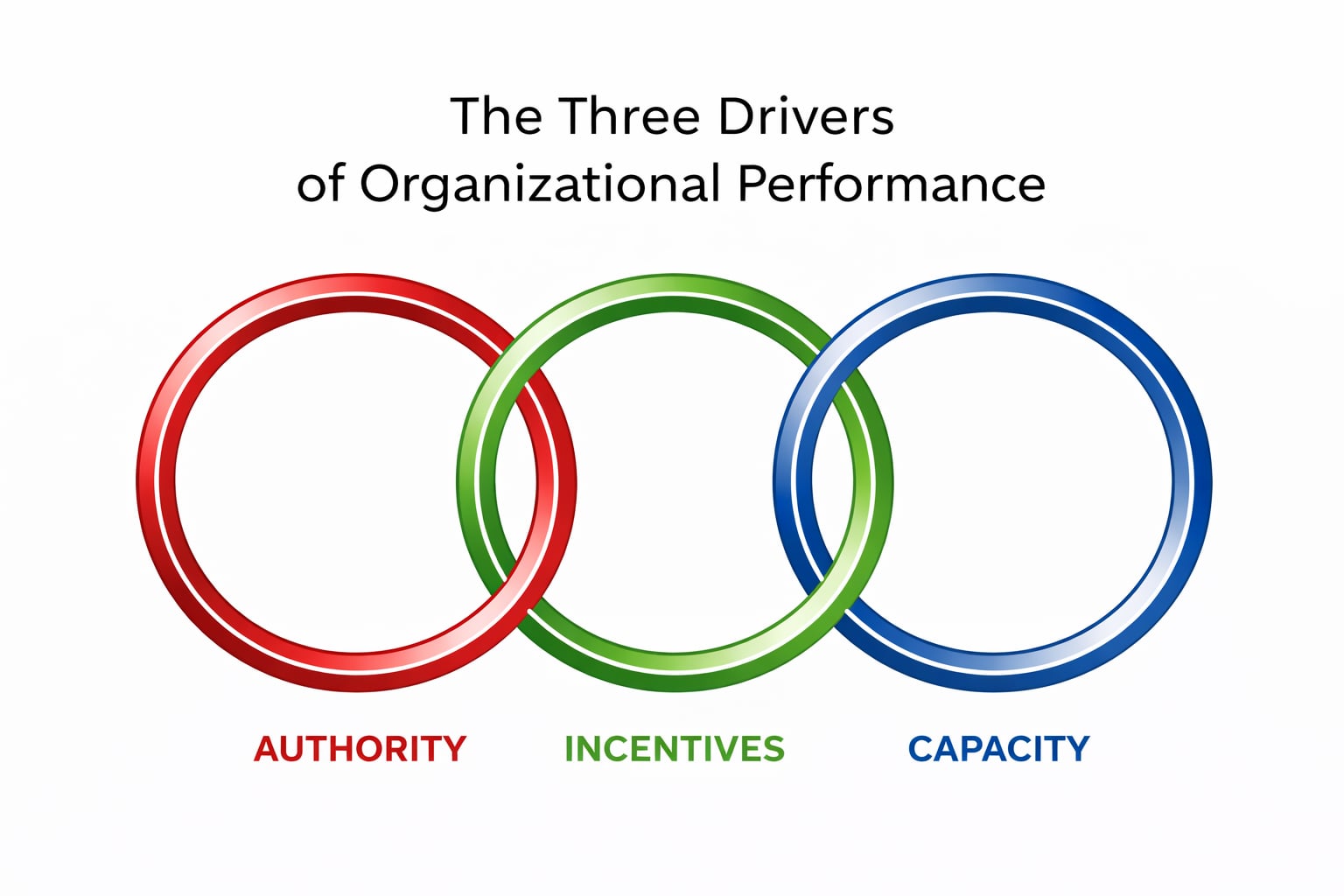
The Three Structural Drivers
Organizational performance is shaped by three structural drivers:
AUTHORITY
Who decides?
Where does ownership truly sit?
Are roles clear or overlapping?Misaligned authority creates hesitation, duplication, and political friction.
INCENTIVES
What behaviors are actually rewarded?
Where are subtle contradictions embedded in the system?Incentive misalignment quietly redirects energy away from strategy.
CAPACITY
Do leaders and teams have the bandwidth, skill, and structural support to execute?
Overloaded systems create entropy—not underperformance.
These drivers determine how energy flows inside the organization.
When they are aligned, momentum increases.
When they are misaligned, friction compounds.
The Five Domains Where Friction Hides
Structural friction typically concentrates in five domains:

Authority and Role Clarity

Relational Safety and Status

Incentives and Motivation Alignment

Communication and Information Flow

Capacity and Resource Reality
Most organizations try to solve downstream behavior.
Human Systems Engineering adjusts the upstream structure.
HOW IT WORKS
Human Systems Engineering follows a disciplined architecture:
Diagnose → Map → Adjust → Reinforce
We identify friction patterns within the three structural drivers.
We map how those patterns express across the five domains.
We adjust leverage points at the structural level.
We reinforce the new design until momentum stabilizes.No force.
No motivation campaigns.
No personality labeling.When friction decreases, usable energy increases.
Momentum becomes a system outcome—not a heroic effort.
WHAT IT IS NOT
It is not motivational speaking.
It is not personality training.
It is not culture “programming.”
It is not a technical process optimization.Technical systems engineering builds infrastructure.
Human Systems Engineering ensures the human operating layer inside that infrastructure functions with clarity, safety, and coherence.
The disciplines complement each other.
THE RESULT
When structural friction is reduced:
Decisions accelerate
Coordination improves
Conflict becomes constructiveLeadership capacity expands
Effort feels lighter
Momentum becomes sustainableReduced drag compounds.
Human Systems Engineering is the disciplined practice of designing conditions where clarity, safety, and momentum can emerge—without force.
Copyrights 2026 | Human Systems Enginnering | All rights reserved